Introduction to the Baltic Report
In the depths of unexplained phenomena, the year 1665 stands out for an event that took place over the skies of Stralsund, Germany. Known as the Baltic Report, this incident has captured the imagination of historians, ufologists, and enthusiasts of the mysterious. Described as an aerial battle, it involved strange objects in the sky and has left many questions unanswered. What transpired during those fateful days? And what could have been the implications of such an occurrence? Let us delve into the details of this intriguing episode from history.
Historical Context
To appreciate the significance of the Baltic Report, it is essential to understand the historical backdrop of 17th-century Europe. This was a time marked by political intrigue, religious conflict, and scientific exploration. The Thirty Years' War, which ravaged much of the continent, had just concluded, leaving a complex tapestry of alliances and rivalries. Stralsund, a significant port city in Northern Germany, was a strategic location in the Baltic Sea, often caught in the crossfire of power struggles between nations.
During this period, the skies were not just the realm of birds and clouds; they were also perceived as the domain of the divine and the unknown. The intersection of war, superstition, and the nascent field of science created a fertile ground for peculiar sightings and reports of the unexplained. It was within this context that the Baltic Report emerged, capturing the attention of local citizens and eventually spreading beyond the boundaries of Stralsund.
The Aerial Battle Unfolds
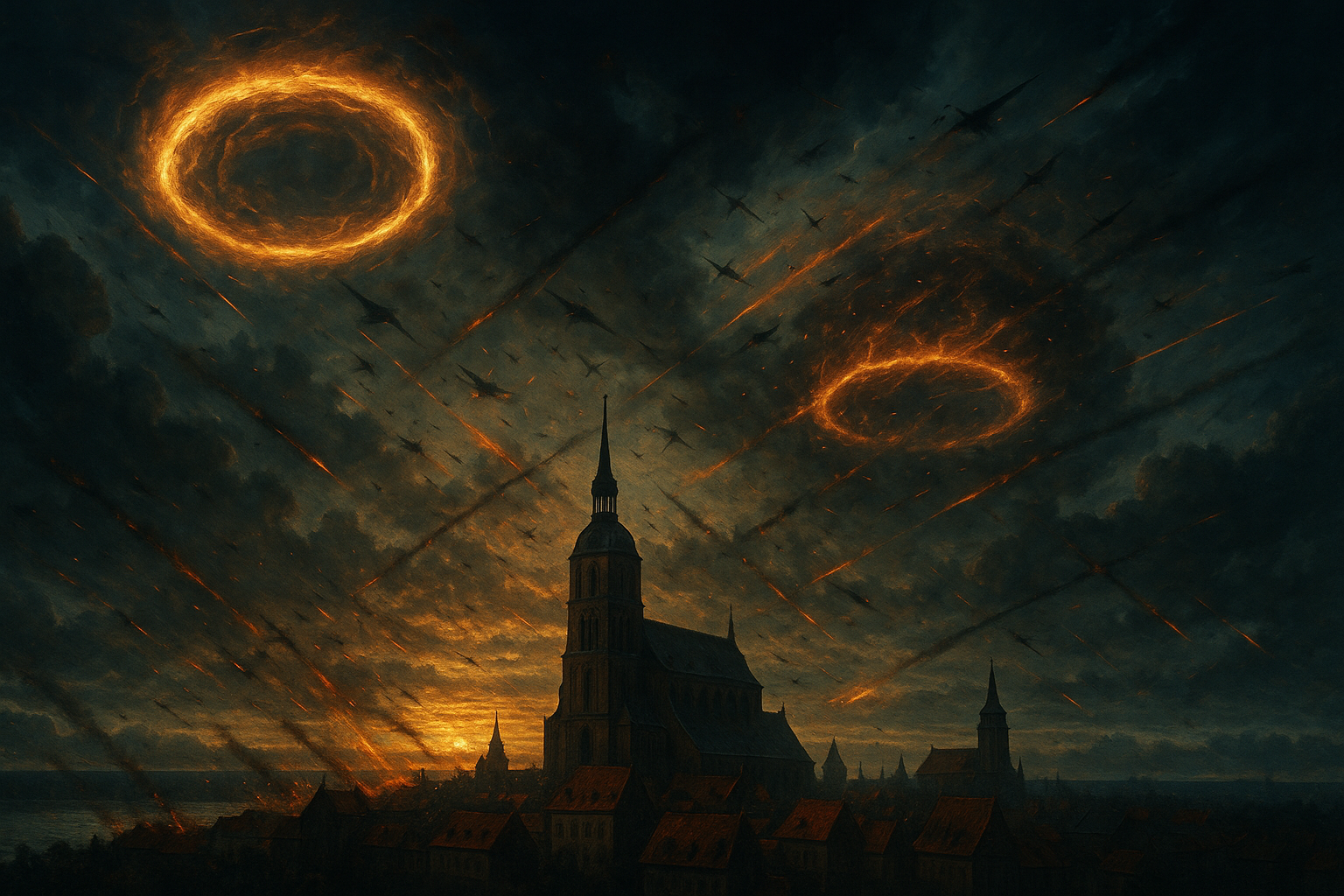
The accounts of the event are varied, with witnesses describing a fierce aerial battle between mysterious flying objects in the sky above Stralsund. The initial sightings were reported by fishermen and sailors, who first noticed strange, brightly coloured lights dancing across the horizon. As the day progressed, the phenomena intensified, leading to a spectacle that would be etched into local lore.
Eyewitnesses claimed to have seen objects resembling discs or spheres, moving with incredible speed and agility. Some described them as emitting loud noises, akin to thunder, while others reported a serene silence enveloping the area, broken only by the sound of waves lapping against the shore. The visual display was said to include flashes of light and vibrant colours, further enhancing the otherworldly nature of the encounter.
Local Reactions and Interpretations
The reactions in Stralsund were as varied as the descriptions of the phenomena themselves. Some residents viewed the aerial display as a divine omen, a sign of impending change or conflict. Others were inclined to consider the possibility of military engagement, believing that foreign powers might be testing new weaponry or engaging in espionage.
Local authorities took the reports seriously enough to investigate the sightings. They interviewed witnesses and sought to discern whether the events were a mere figment of imagination, a collective hysteria, or something more tangible. The lack of conclusive evidence led to a spectrum of interpretations, with some insisting on a rational explanation, while others remained convinced that what they had witnessed was beyond human comprehension.
The Legacy of the Baltic Report
The Baltic Report has lingered in the collective memory of Stralsund and beyond, evolving into a legend that intertwines history with the unexplained. Over the centuries, the incident has inspired numerous theories, ranging from military experiments to extra-terrestrial involvement. Each retelling has added layers of intrigue and speculation, ensuring that the story remains alive in popular culture.
In recent years, as interest in unidentified aerial phenomena (UAP) has surged, the Baltic Report has attracted renewed attention from researchers and enthusiasts alike. Some have sought to analyse historical records, while others have looked for parallels in more contemporary sightings. The event has become a touchstone for discussions about humanity's place in the universe and the mysteries that lie beyond our understanding.
Connecting the Dots: Historical Sightings and Modern UAP
What makes the Baltic Report particularly compelling is its connection to a broader tapestry of historical sightings of unexplained aerial phenomena. From the "Foo Fighters" of World War II to the recent revelations regarding UAP by military personnel, the human fascination with the skies has persisted. The Baltic Report serves as an early example of this enduring intrigue, raising questions about what we have yet to discover.
As we examine these historical accounts, it becomes clear that the desire to understand the unknown is a fundamental aspect of the human experience. The Baltic Report challenges us to consider the limits of our knowledge and the potential for phenomena that defy explanation. In an age where technology has advanced dramatically, the mysteries of the sky continue to elude definitive answers.
The Unexplained Endures
The events of 1665 in Stralsund remain a significant chapter in the dialogue surrounding unexplained phenomena. While the Baltic Report may not provide the clear answers that some seek, it invites us to explore the boundaries of our understanding and to remain open to the possibilities that lie beyond. History often intertwines with the unknown, and the aerial battle over Stralsund serves as a poignant reminder that our quest for knowledge may be as turbulent as the skies themselves.
As we continue to investigate the unexplained, we find ourselves drawn to the stories of those who came before us, who, like us, gazed into the sky and pondered what they could not see. The legacy of the Baltic Report reminds us that the skies are not just a canvas for our imagination but a realm that may still hold secrets waiting to be uncovered.
If you enjoyed reading this article then why not consider taking a look at this book on Amazon.
If its not for you, then maybe a family member would appreciate it as a gift?