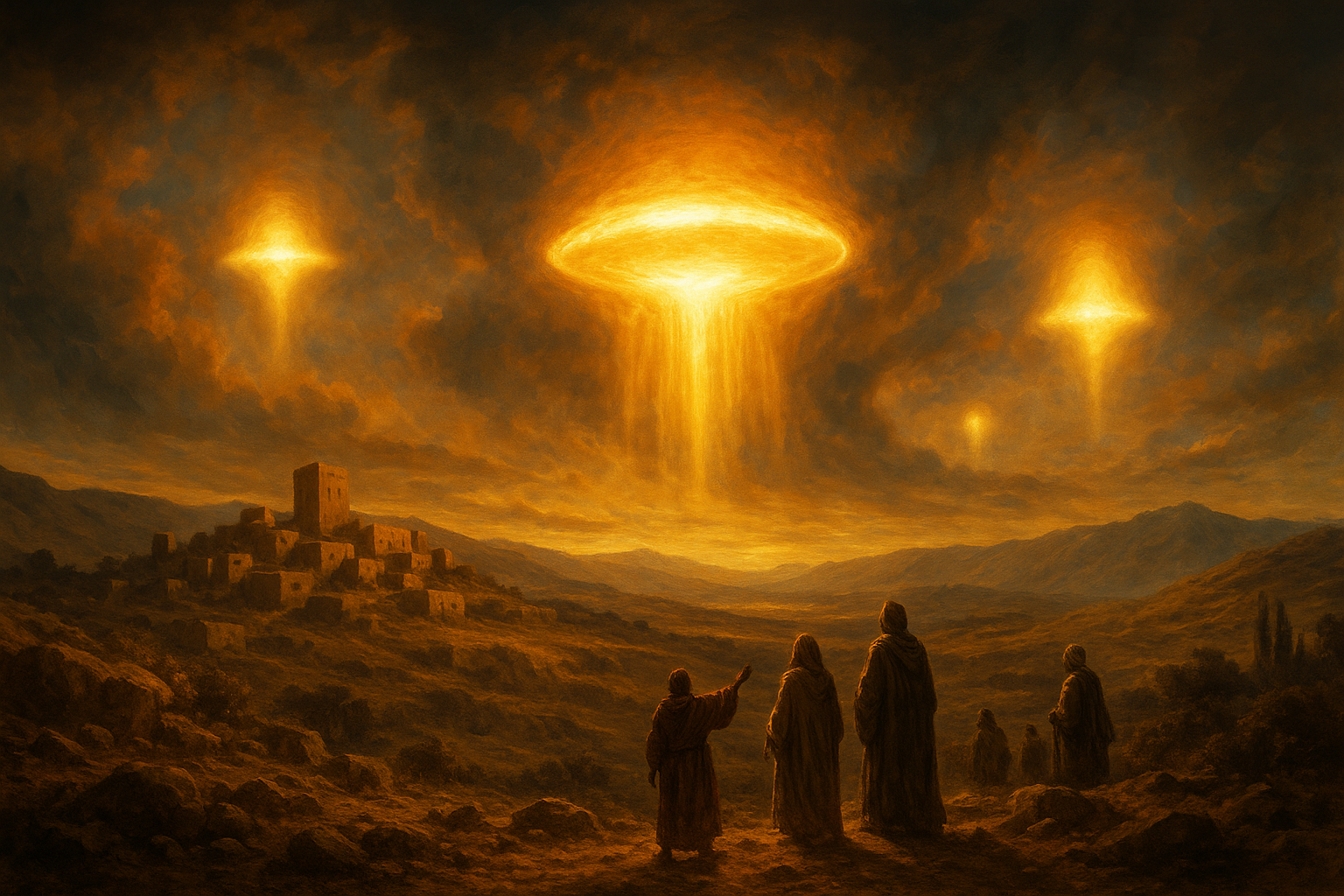
The Historical Context of 50 CE
The year 50 CE stands as a significant period in the annals of history. It was a time when the Roman Empire was at its zenith, expanding its territories and consolidating power across the Mediterranean. Meanwhile, Judea, a small but strategically vital province, was experiencing a tumultuous period of political unrest and cultural transformation. The Jewish population was grappling with the influence of Roman rule, the encroachment of Hellenistic culture, and the burgeoning ideas that would eventually lead to the development of Christianity.
Amidst this backdrop of socio-political upheaval, accounts of unusual phenomena began to emerge. One such phenomenon, documented by various historians and chroniclers of the time, involves luminous formations observed over the skies of Judea. These sightings would go on to become the subject of speculation, analysis, and even reverence, as they were interpreted through the lens of spirituality, prophecy, and the supernatural.
Accounts of Luminous Formations
The sightings of luminous formations over Judea were not confined to a single event but rather were reported sporadically throughout the region. Descriptions varied, but many accounts depicted bright, glowing objects that moved with remarkable speed and agility, often changing direction abruptly. Some witnesses claimed that these formations emitted a radiant light that illuminated the night sky, while others described them as flickering, like a firefly in motion.
One notable account comes from the writings of Flavius Josephus, a Jewish historian who documented the Jewish-Roman wars and provided insights into Jewish life during this era. Josephus recounted sightings of "fiery chariots" in the air, which he interpreted as omens of impending doom or divine intervention. Such descriptions were not unique to him, as other historians and chroniclers of the time also recorded similar phenomena, suggesting that these sightings were widespread and could not be easily dismissed.
Interpretations and Theories
The luminous formations observed over Judea elicited a range of interpretations, largely dependent on the cultural and religious beliefs of those who witnessed them. For many, these sightings were seen as divine messages or omens. The Jewish populace, steeped in rich religious traditions, often interpreted celestial phenomena as harbingers of significant events. The idea of heavenly signs was deeply rooted in their beliefs, and many viewed these luminous formations as a call to repentance or a signal of forthcoming divine intervention.
In contrast, some individuals in the Roman Empire may have approached these phenomena with a more pragmatic mindset, seeking scientific explanations. The lack of understanding of atmospheric phenomena during this time meant that many were left to grapple with the unknown. Some scholars have suggested that these sightings could have been attributed to natural occurrences such as meteors, comets, or even unusual weather patterns. However, the sheer consistency and specificity of the reports raise questions about such explanations.
Modern Perspectives on Ancient Sightings
Contemporary researchers and enthusiasts often delve into these ancient accounts with a fresh perspective, exploring the possibility that they may represent encounters with unidentified aerial phenomena (UAP). This branch of study seeks to understand the unexplained objects and lights reported throughout history, particularly those that cannot be easily classified as natural or man-made. The luminous formations over Judea serve as an intriguing case study in this regard.
Modern technology allows us to analyse historical texts and accounts with greater precision, and some researchers have attempted to correlate the sightings with astronomical events. For instance, alignments of planets, meteor showers, or even atmospheric phenomena like ball lightning have been suggested as possible explanations. Yet, the fact that these formations were repeatedly framed within a mystical or divine context complicates straightforward scientific interpretations.
The Legacy of the Luminous Formations
The luminous formations over Judea, whether seen as divine omens or natural occurrences, left an indelible mark on the historical narrative of the region. They contributed to the larger tapestry of beliefs about the supernatural and the divine during a time of significant cultural transition. The interpretations and discussions surrounding these sightings reflect a society grappling with the intersections of faith, politics, and the unknown.
As Christianity began to emerge, so too did the narratives surrounding miraculous signs and wonders. The early followers of Jesus, many of whom were based in Judea, would have been influenced by these accounts, weaving them into the fabric of their own beliefs and teachings. The luminous formations can thus be seen not only as historical curiosities but also as part of the larger narrative of religious evolution in the region.
The luminous formations over Judea in 50 CE represent a fascinating intersection of history, spirituality, and the unexplained. Whether viewed through the lens of ancient belief systems or modern analytical frameworks, these sightings challenge our understanding of the past and encourage us to explore the mysteries that have persisted through time. They remind us that even in an age dominated by reason and science, the allure of the unknown continues to captivate the human imagination. As we delve deeper into our historical narratives, we may find that the luminous formations over Judea are just one of many threads in the complex tapestry of human experience, urging us to question, explore, and seek understanding beyond the visible horizon.
If you enjoyed reading this article then why not consider having a look at this book on Amazon.
If its not for you, then maybe a family member would appreciate it as a gift?