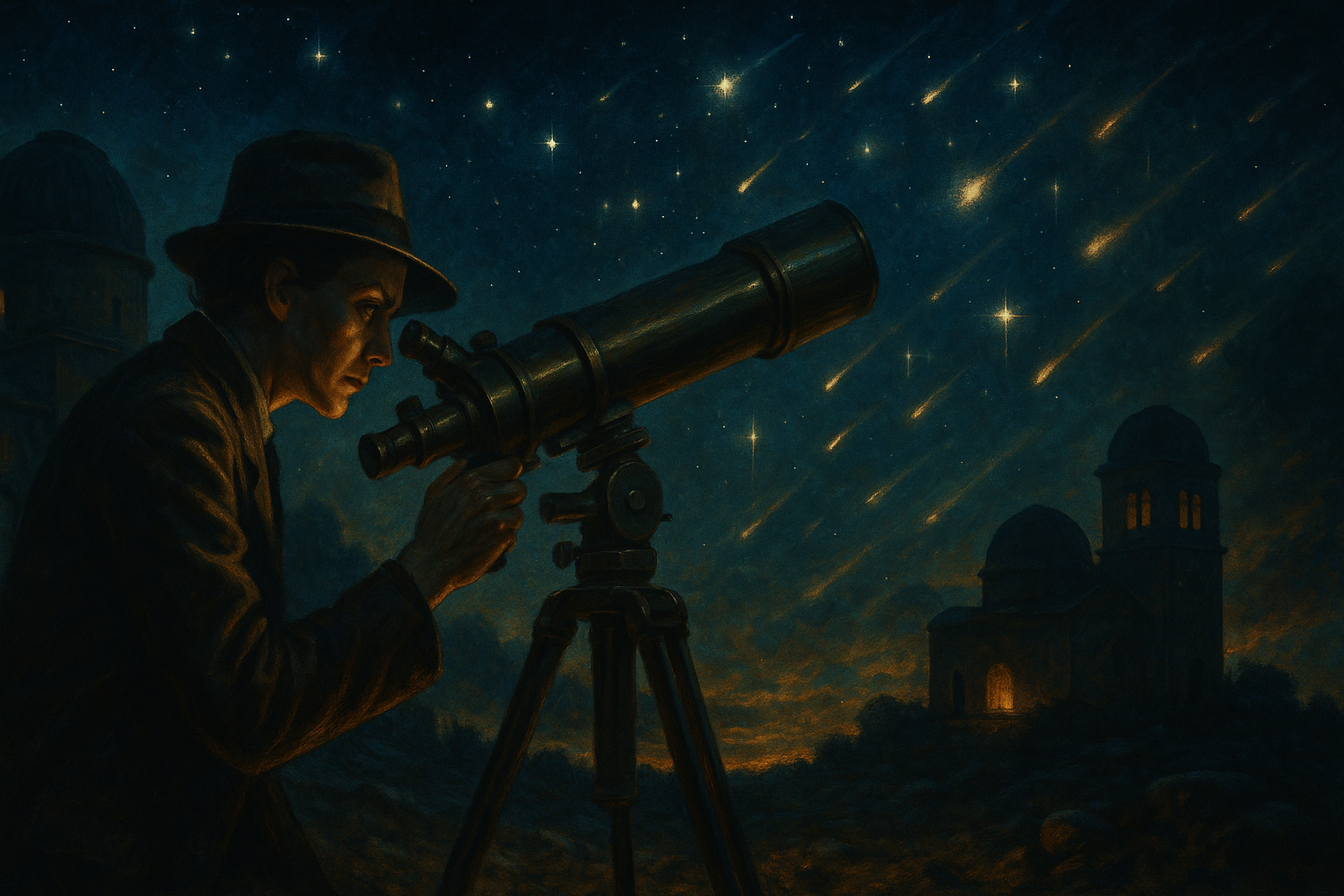
The Vanishing Stars of 1952: Has Science Uncovered Orbiting Objects Pre-dating Sputnik?
Imagine looking at a night sky photo taken in the 1950s, seeing a cluster of bright, pinpoint stars, and then looking at the exact same spot months later to find they’ve completely disappeared. No supernova, no leftover dust, no trace at all.
Even stranger? The night one of these famous photos was taken, military radar was locked onto unidentified flying objects hovering directly over the U.S. Capitol.
It sounds like a sci-fi thriller, but it’s the core of real, peer-reviewed research led by Swedish astrophysicist Dr. Beatriz Villarroel through the VASCO (Vanishing & Appearing Sources during a Century of Observations) project.
The Photographic Artifacts That Shouldn't Exist
In 1950, astronomers at the Palomar Observatory began cataloguing the night sky using high-resolution glass plates. This was seven years before Sputnik 1, meaning there was officially zero human-made satellite hardware orbiting Earth.
When Dr. Villarroel and her team used modern algorithms to cross-reference these historical plates with present-day sky surveys, they discovered over 100,000 "transients"—points of light that appear in single exposures and then vanish forever.
While a astronomical flare might explain a few, many of these glints don't leave streaks like asteroids or meteors do during a 50-minute exposure. They appear as sharp, circular points—exactly what you'd expect from sunlight reflecting off a flat, metallic object briefly catching the sun in high Earth orbit.
The Washington, D.C. UFO Flap Overlap
On July 27, 1952, a wave of radar detections and visual sightings swept across Washington, D.C., causing fighter jets to scramble over the White House and Capitol building. It remains one of the most famous "UFO flaps" in history.
On that exact same night, the Palomar Observatory took an exposure of the night sky. On that single plate, a cluster of transient flashes appeared in a narrow line.
When Villarroel’s team cross-referenced National UFO Reporting Centre (NUFORC) records with historical telescope logs, they found a statistically significant link: Transient sky flashes increased by ~8.5% on days with high numbers of UAP sightings on Earth.
The Nuclear Connection and "The Shadow Deficit"
The correlations didn't end with Washington, D.C. The VASCO team uncovered two other startling statistical patterns:
- Atmospheric Nuclear Tests: Transient flashes on sky plates were 68% more likely to appear the day after an atmospheric nuclear detonation.
- The "Shadow Deficit": The team observed a sharp drop in these pinpoint flashes whenever the telescope looked into Earth’s shadow cone. If the flashes were purely internal plate defects, Earth's shadow wouldn't affect them. The fact that they drop off in Earth's shadow suggests the lights require direct sunlight to reflect off something.
Alternate Explanations: Plates or Probe?
Naturally, extraordinary claims require extraordinary evidence, and mainstream astronomers are approaching these findings with healthy scepticism.
THEORY 1: Plate Contamination
- The Argument: Radioactive fallout from nuclear tests or chemical defects damaged glass plates.
- The Counter-Argument: Doesn't explain why flashes drop off in Earth's shadow.
THEORY 2: Head-on Meteors
- The Argument: A meteor heading directly toward the telescope lens looks like a point, not a streak.
- The Counter-Argument: Statistically improbable to happen in clusters on single plates.
THEORY 3: Non-Human Artifacts
- The Argument: Reflective objects (probes or debris) were in Earth orbit prior to 1957.
- The Counter-Argument: Lacks direct physical recovery; requires ruling out all optical anomalies first.
What Comes Next?
Dr. Villarroel and the VASCO project aren't claiming they've found alien spacecraft, they are letting the statistical anomalies speak for themselves while running modern imaging tests on original glass plates to eliminate chemical defects once and for all.
Whether these transients turn out to be unprecedented atmospheric physics, obscure plate chemistry, or something in orbit long before human spaceflight began, the mystery of 1952 remains one of the most compelling intersections of astronomy and high-strangeness on record.
If you enjoyed reading this article then why not consider taking a look at this book on Amazon.
If its not for you, then maybe a family member would appreciate it as a gift?
https://www.amazon.com/dp/B0H5CZD5H2